
Interviews With Truth
How To Understand Monk Mentality

We're in a time of unprecedented knowledge availability.
As a result, we are no longer limited to the religious understanding of our native culture.
Wisdom from most of the world's traditions is available at our fingertips.
Can you see it?
Thousands of spiritual coaches thrive across social media.
People claim nonreligious in various demographic surveys.
People are looking to cultural traditions and synthesizing what resonates to them.
AI texts and images give people the insights and visions that they once could only get from religious devotion.
People are finding online communities that support their synthesized spirituality.
People are missing out on the roots and chain of personal transmission that the wisdom was extracted from.
These are all connected to the reliance and faith people have placed on search engines, knowledge databases, and message boards
The internet holds a lot of data, yet there is still a whole universe of information that can only be found
There is no substitute for real life experience.
If you want to connect to people tapped into the roots of the spiritual wisdom that you resonate with, technology and the internet can help you with that too.
You only have to seek it out.
The Journey
Ever since I was a high school exchange student in Thailand, I have had a particular affinity for the Thai Forest Tradition.
In oversimplified summary, the That Forest Tradition is a lineage of Theravada Buddhism in Thailand that values connection with nature and community (putting the teachings—dhamma—to practice) over the typical practice at the time it was established (a diluted monastic code and fixation on texts).
Established at the turn of the 20th Century, the Thai Forest Tradition is responsible for saving what’s left of the forests of Thailand from clear-cutting.
My introduction to this lineage was through Ajahn Chah, one of the first Thai monks to welcome Westerners into the practice.
Through the magic of YouTube algorithms, I started listening to the dhamma talks of Thanissaro Bikkhu. He records the messages he gives at the temple every morning and night — two new messages per day.
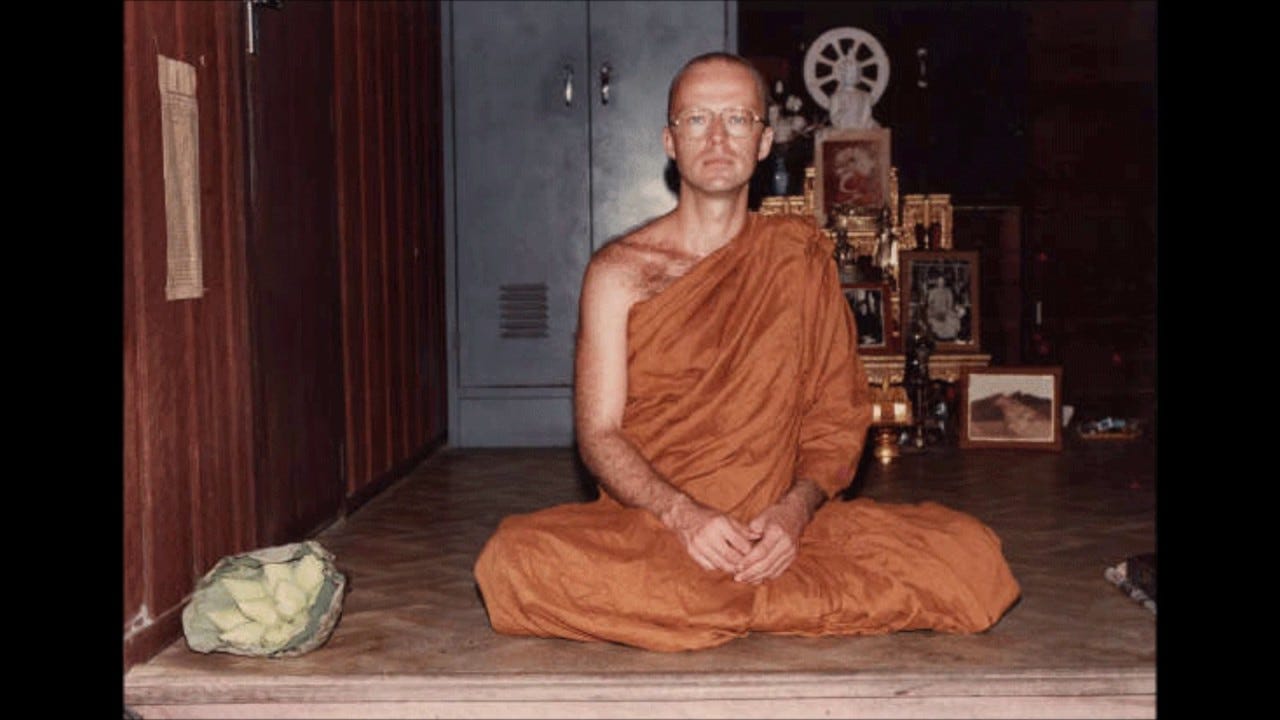
I resonated with the way he describes the mind, and I kept returning to his recordings. One day I had a realization — he lives in southern California at Wat Metta Forest Monastery… I can go there.
What better opportunity to get tapped into the current of wisdom than to visit a living master.
Within a year, my friend in Southern California invited me to his wedding. I added a trip to the monastery to my itinerary and I began planning my visit.
The first thing I learned when I got there is that being in a place around people who are dedicated to a meditation practice has an effect on your own practice.
I didn't have the most consistent meditation practice leading up to my stay at the monastery. However, when we went into the meditation hall for the evening meditation on my first night, I had no problem sitting for the full hour.
Every day we had the opportunity to ask questions to the abbot of the temple, and he draws upon his lifetime of experience and study to give us appropriate answers.
Here are the five main lessons I learned during my week-long stay at Wat Metta Forest Monastery.
1. Anthropologist From Mars
One thing about staying at a monastery is that the problems and distractions of daily life are minimized. While staying there, you are supported by the community—sangha.
It may feel difficult to keep up the same determination in your practice outside the sangha of a monastery. When everyone around you doesn't value the same internal calmness that you do, the mind can lose its focus on what really matters.
There may be temptations to join in exciting activities. If you are interested, go in as an anthropologist from Mars.
As if you are observing this human behavior for the first time, notice:
What is appealing about the activity
How the behavior of others is modulated
What is the value of the activity
How does it align with your commitment to inner harmony
When you go into these situations, you’ll come across many rituals revolving around instant gratification.
Keep your reservations to protect your long-term happiness. Over time, you will develop the skill of recognizing the value of the activities.
This discernment coupled with your commitment to self-cultivation will create the intrinsic boundary for you to turn down the short term happiness guilt-free.
2. Eyes Open Or Closed?
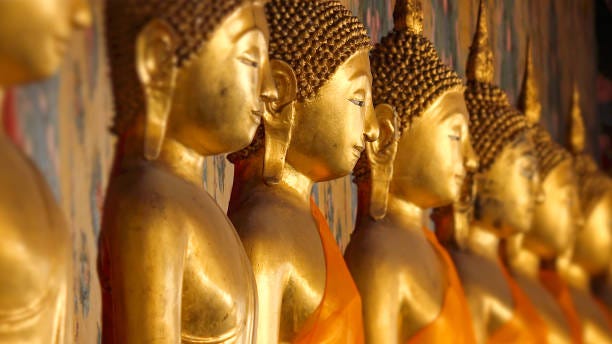
You might notice that many Buddha statues have their eyes slightly opened while appearing to be meditating.
Different lineages have different meditation techniques.
Since I began with Theravada schools of Buddhism, I was taught to meditate with the eyes closed.
When I started meditating with a Soto Zen sangha, I was instructed to keep my eyes open and look toward the ground one meter ahead.
Zen’s practice of eyes opened meditation is embedded in their legends. Bodhidharma, the first patriarch of Zen, once tore off his eyelids because he kept falling asleep during his meditation. Where his eyelids landed, the first tea plants grew.
Keeping the eyes closed during meditation helps to reduce distractions.
There are fewer things to look at, so your mind will wander less.
Keeping the eyes opened slightly helps to stay awake.
It may produce more distractions, but if you're having trouble nodding off with the eyes closed, then open your eyes slightly.
During eyes opened meditation, use a soft gaze with unfocused eyes. Attempt to take in the entire perceived field of view—the periphery and what's in front of you—all as one.
Interestingly, I have heard the opposite explanation regarding the eyes in Zen.
My Zen teacher said that they keep the eyes open because it provides fewer distractions.
The idea being that, if the eyes are open, then the mind will be less prone to daydreaming and wandering off from the object of meditation.
I can agree with this to a certain extent, and I see it as a great starting point for bringing the mediation off of the cushion.
If you can meditate with the eyes open, then you can keep that meditative mind as you stand up and go about your daily tasks—in theory.
One thing is for certain—if you are meditating in the darkness of the night, it doesn't really make a difference if your eyes are opened or closed, everything appears as pitch black darkness.
3. Caffeine is an acceptable drug
This one has always been a sticking point for me. After all, the fifth precept is to refrain from intoxicants. Drugs are intoxicants, and caffeine is a drug.
To understand this, I had to get my mind out of the current idea of how we classify drugs.
In the past, tea was seen as a medicine. It was seen as a plant that gave you more energy and focus. How could this be seen as anywhere near the same category as alcohol (another drug).
The modern categorization of substances leaves people grouping drugs together, dissociating them from plants of their original form.
I'm not sure of the thoroughness of the translation, but I've heard it suggested more than once that this precept is primarily referring to alcohol.
The idea is that intoxicants refers to substances that will lead to poor judgement when consumed. This makes sense because tea has been used to strengthen concentration of meditators for eons.
However, the concern I have is that when the supply of caffeine runs out, it has adverse effects on the user.
I suppose the idea is to simply not run out of coffee or tea and everything will be okay.
After thinking for a while, I concluded that it is similar to any food product. If you go without food for a day, I think most people would have some adverse effects and symptoms of withdrawal. Let alone, if you stopped drinking water for a day.
So, I continue drinking tea daily, and I view it as a third type of appetite now. I have an appetite for water to stay hydrated, an appetite for food to stay nourished, and an appetite for tea to stay focused.
4. Mind The Spirits
Whether you believe it or not, many reliable people over the years have agreed that spirit beings—devas—exist.
Some people devote a lot of attention and ritual to communicating or appeasing spirits.
One of the main messages of Buddhism (at least in this lineage) is that caring for your own well-being is a higher priority than appealing to the devas.
They are always around, and can be witnessed by attuning your mind—think of it like tuning into a radio station.
Some of them exemplify great virtue
Some of them may be full of ignorance
Others may be a nuisance
If you don't already notice their presence, then don't worry about it.
Engaging in practices for developing the ability to see spirits can lead to delusions which take you further away from the objective of practice—your own true happiness.
If you do have contact with them, they can be called upon to help reflect on positive qualities and bring blessings.
Either way, the best use of your efforts is learning to be self-reliant for your own mental and emotional well-being.
5. A Promise To Yourself
When you are not practicing in solidarity with a sangha, your mind will start to invent reasons to skip your meditation practice.
I’m tired
I feel like watching a movie
There is a party tonight
I feel like sleeping in
Your mind has been practicing your whole life to keep you moving in a reactionary direction. I has become skilled at creating convincing excuses.
Remind yourself of why you want to practice meditation.
Increased presence
Higher emotional intelligence
More efficient problem solving skills
Cultivating peace within yourself = cultivating peace in your community
Tell yourself that your practice is a promise you made to yourself.
Promises to yourself are just as valid as promises to others, and should be respected as such. Most people find it so easy to keep your promises to others.
Yet, when you make a promise to yourself, you often break it over and over again.
Remember that you get to do these things, you don’t have to. You have discovered something that you know will give you long term happiness. What an amazing opportunity!
Consider how many people there are in the world who feel discontent with their life and do not have any tools to help them find the way out of the feeling.
Take advantage of the fact that these beautiful teaching have found their way to your consciousness. Don't let this amazingly influential knowledge of the path to true happiness and understanding of discontentment.
Drink of the water of the end of suffering voraciously.
What allows you to keep this promise is foregoing short term happiness for long term happiness.
Typically, when you know the right path to long term happiness, any distraction from that path provides only short term happiness. It's okay, just acknowledge that it is not the best thing you can be doing in the moment. Everything changes, though, even our desire to do our best from moment to moment.
Remember why you wanted to start meditation in the first place.
Out of all history and all places to be be born, it is rare that you have been guided to this path of wisdom and meditation. Now that you see the way to go, there is no excuse why you should hesitate walking the way.
The chain of teachers that brought these lessons to the present day have already done a tremendous amount of work for you. The least you can do is take one step a day. Nobody is going to do the work for you and only you can share the gratitude that you have been bestowed with.
Sometimes you can use external motivation as a jump start.
One way you can do this is to imagine how the elders of the past would perceive you if they were watching. Would they be proud that you are peeling back the layers that separate you from the true reality. Or, would they be disappointed in your lethargy.
Let this be the thing that kicks you into gear.
Essentially, you are observing yourself, and you are judging yourself from the perspective of the elders.
Keep a promise to them first. Then,
Learn to keep the promises you make to yourself.
Bonus- 3 Levels of Power of Chanting
While I was visiting the monastery, I experienced first hand the power of chanting. There were two group meditations per day and before each one was a short chanting session. It didn’t take long for me to notice that chanting before meditation allowed my mind to settle much more easily
It’s like the chants set up a nest for the mind to rest in.
During a question and answer session, I learned there are three levels (not in a hierarchical sense) that the chanting operates on.
The feeling of saying it. - The vibration of your body as you say the chants and the rhythm that you say them in. These aspects are relaxing and comforting to your mind and body on a physiological, psychological, and emotional level. Doing these chants daily allows for a re-tuning of the baseline for relaxation.
The meaning of the words. - Most people chant the words without knowing what they mean. After a while, the studious practitioner will start to recognize some words here and there—similar to how a child starts to pick up words bit by bit through exposure.
Knowing the meaning of the words that are being chanted adds a whole new layer of power to the practice of chanting. When you know what you are saying in the chant, you are consciously guiding your mind to contemplate the various aspects of the chant. In this way, knowing the meaning of the chant allows you to remind yourself about the lessons of dhamma on a daily basis.
The act of hearing the chant. - As the mind hears the chant (whether it’s your own voice alone, or with a group or recording), it commits it to the subconscious. Not only are you saying the dhamma when you chant, but you are hearing the dhamma. Your own voice is going into your ears, and you are able to hear the chants as if a teacher is giving you a lesson. While your conscious mind is focused on delivering the message that you are speaking, your subconscious mind is open to receiving the messages of the chants. You are the teacher and the student every day when you practice chanting. Keep reminding yourself of how to be more skillful in this life.
When you practice chanting, you are your own teacher and your own student.

Integrating Dhamma Into Your Life
When you focus your energy on the dhamma, you will start to see the dhamma around you more and more.
Like the red car theory—energy flows where attention goes.
Sometimes in your meditation, you will start to notice where your mind goes when it wanders off. You may start to see visions of things.
These "random" thoughts and visions hold insights for you to discover.
Setting time aside to analyze and contemplate how the dhamma—the lesson—is expressing itself will allow you to build up your wisdom bank. As this bank of wisdom grows, your ability to make consistently skillful decisions increases.
However, it is important to remember that following the wise path is always a choice. There doesn't come a time when suddenly there is no more effort and you naturally make perfect choices and the appeals of the body and the lower desires lose their power.
You just develop better shields against their influence and more powerful tools to cut them down.
They never go away, it is a part of this life.
It is a part of being human.
I tell stories and write poems. Posts about tea, exercise, and meditation fill my Substack. Subscribe now and get these posts emailed to you.
Follow my Seidowrites X account for daily insights about staying on the path.
I learn a lot from the feedback I get on my posts. Help me by commenting what was most interesting or impactful about Interviews With Truth.
Have a haiku as a reward for reading all the way to the end.
Sip white tea
Sniff a gardenia
Ring my bell